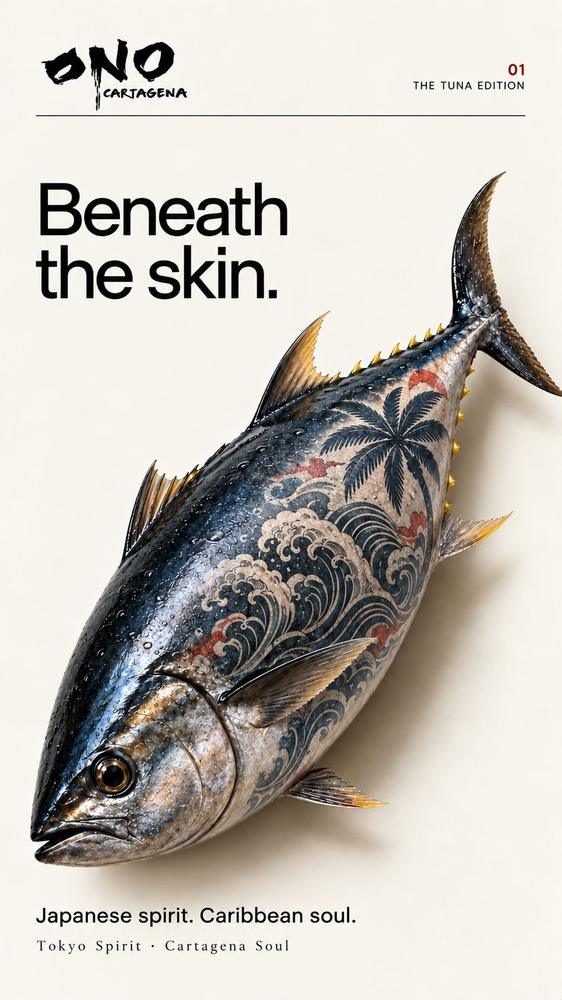
The series is called Beneath the skin. Each piece is a fish from the menu, tuna, eel, salmon, hamachi, its body covered in tattoos of waves, palms and flowers, as if the sea itself had been engraved on it. It's art, but it's also a way of saying something about ONO's kitchen: what matters lies beneath the surface.
What is irezumi
Irezumi is the name for traditional Japanese tattooing. It became popular in the Edo period, when woodblock prints filled the streets with images of heroes, dragons and waves, and tattooists began carrying those images onto skin. Its pieces cover back, arms and legs as a single drawing, set against water, clouds and wind.
Waves and koi
Waves are one of the most recognisable motifs in Japanese art, and none is more famous than The Great Wave off Kanagawa, Hokusai's print from the early 1830s. Koi carp have their own legend: the fish that swims up the waterfall against the current and, reaching the top, becomes a dragon. That's why they stand for perseverance.
What matters lies beneath the surface.
From skin to plate
At ONO, Beneath the skin is also a way of cooking. Hosomaki hides nothing: rice, nori and a single fish. If the cut is good and the fish is fresh, you notice; if not, you notice too. That's why the series shows the whole fish, tattooed, before it becomes a piece. Read what is hosomaki to see why, or browse ONO's gallery.
ONO is at Calle 84A #9-11, Bogotá, Tuesday to Saturday, 7 pm to 3 am. Book your table online.